
MIPS 2026 in 10 Steps
A practical roadmap for EHRs and provider organizations
MIPS is a year-long process, not a year-end submission task.
Reporting strategy, technology, measures, workflows, documentation, and performance build on one another.
This guide organizes MIPS action items for EHRs and provider organizations into 10 steps across 3 phases.
MIPS at a Glance
Quality
Full year
Measure performance and data capture
Cost
Full year
Claims-based performance. No submission
Promoting Interoperability
180 days minimum
Performance and attestation
Improvement Activities
90 days minimum
Completion and documentation
Important: MIPS performance in 2026 affects the 2028 Medicare Part B payment adjustment. Early decisions can improve MIPS readiness and performance.
Phase 1 - Set the Reporting Foundation
Step 1. Confirm your MIPS reporting strategy
Your MIPS reporting strategy determines the path you support or participate in: Traditional MIPS, MVP, or MIPS APM, and whether reporting is individual or group-based.
These decisions affect measure requirements, scoring, submission, and payment adjustments. Decide early.

EHRs
- Define which reporting pathways you will support
- Confirm required certified technology
- Determine which Quality measures you will support, including eCQMs and MIPS CQMs
- Assess the development, integration, and support impact of each pathway

Provider Organizations
- Select the reporting pathway that best fits your specialties and structure
- Confirm which clinicians, TINs, and locations are in scope
- Choose individual, group, or applicable subgroup reporting
- Assign clear ownership for MIPS strategy and execution

Where MyMipsScore adds value
MyMipsScore helps EHRs and provider organizations choose a reporting strategy based on feasibility, scoring potential, and operational impact.
Review your MIPS reporting strategy →Compare reporting levels and MIPS pathways
Step 2. Decide if MVP is the right fit
MVPs can simplify reporting, but they also narrow your choices. Each MVP defines the available Quality measures and Improvement Activities, which can affect measure support, data capture, scoring, and submission.
Before choosing an MVP, the EHRs and provider organizations must confirm they can support it operationally throughout the performance year.
EHRs
- Confirm MVPs to support and all their required measures
- Verify required data can be captured in structured form
- Identify development changes or integration needed for Quality, PI, and IA
- Confirm scoring, aggregation, and submission support for the selected MVPs
Provider Organizations
- Choose an MVP that fits your specialty and care delivery
- Review available measures, activities, and scoring potential
- Confirm consistent workflows and data capture across sites
- Understand MVP registration requirements and deadlines
TIP: Do not choose an MVP simply because it requires fewer measures. Confirm that the EHR can support it and the provider organization can perform well under it.
How MyMipsScore supports MVP readiness
MyMipsScore helps teams assess MVP readiness, measure support, scoring potential, and submission requirements before committing to an MVP.
Assess your MVP readiness →What changes with MVP reporting
Step 3. Define what you need to report
Define the Quality measures, Improvement Activities, PI requirements, attestations, integrations, and workflows your reporting path requires.
A familiar or clinically relevant measure is not automatically a good reporting choice. Confirm that each measure is current, supported, feasible, and scorable.
EHRs
- Confirm current-year measures and specifications are supported
- Update measure logic, calculations, and required data elements
- Verify structured data capture and reporting output
- Map measure support across Traditional MIPS and relevant MVPs
- Confirm PI and IA attestations and ONC certification requirements
Provider Organizations
- Confirm the required Quality measure set availability for your reporting path
- Shortlist measures based on clinical fit, data reliability, and scoring potential
- Check case volume, benchmarks, and topped-out status early
- Confirm measures work across providers, specialties, and locations
- Compare eCQM and MIPS CQM options when both are available
How MyMipsScore helps
MyMipsScore helps teams evaluate current measure specifications, scoring potential, data capture, and workflow feasibility before finalizing their reporting scope.
Review your MIPS measure strategy →MIPS measure considerations
Phase 2 - Execute Across Performance Categories
Step 4. Choose Improvement Activities early
Improvement Activities are easy to underestimate. The challenge is usually execution: selection, ownership, participation, documentation, and audit evidence must all line up.
For MVP reporting, confirm early that the required IA is practical to complete for all participating clinicians at all locations.
EHRs
- Confirm which Improvement Activities you will support
- Define required data, workflow, and documentation support
- Make audit evidence requirements clear
- For MVPs, confirm support for the activities included in the supported pathway
Provider Organizations
- Choose activities that fit existing workflows
- Confirm performance-period and participation requirements
- Check special-status eligibility and applicable IA requirements
- Assign clear ownership and maintain audit-ready documentation
- For MVPs, confirm the activity is practical across participating clinicians and locations
TIP: If an Improvement Activity depends on participation across sites, define the owner, documentation process, and evidence source early.
Where MyMipsScore helps
MyMipsScore helps teams select feasible Improvement Activities, clarify documentation requirements, and stay ready for attestation and submission
Validate your IA planning →IA reporting considerations
Step 5. Confirm PI applicability and readiness
Promoting Interoperability (PI) measures how clinicians use a certified EHR to exchange health information, prescribe electronically, and give patients electronic access to their health information.
Determine early whether PI applies, whether the EHR supports the required capabilities, and whether automatic reweighting or a hardship exception may apply. Gaps in certification, integrations, or workflows can take time to resolve.
EHRs
- Confirm support for all required PI measures and data capture
- Verify the ONC-certified capabilities required for PI, including the (g)(10) FHIR API
- Support measure calculations, exclusions, and attestations
- Confirm PI support across Traditional MIPS and applicable MVPs
Provider Organizations
- Confirm whether PI applies to the reporting entity
- Check automatic reweighting and hardship exception eligibility early
- Verify your EHR supports required PI measures and workflows
- Understand how reweighting affects PI score and overall MIPS score
- Plan for the required PI performance period
How MyMipsScore helps
MyMipsScore helps EHRs and provider organizations assess PI applicability, identify support gaps, understand reweighting implications, and plan for the minimum 180-day performance period.
Assess your PI readiness →PI applicability and reweighting
Step 6. Keep PI workflows on track
Certified technology alone does not ensure PI success. Performance depends on consistent workflows, data capture, and documentation throughout the reporting period.
EHR capabilities and provider workflows must stay aligned across providers and locations. The same PI requirements apply to Traditional MIPS and MVP reporting.
EHRs
- Ensure required PI functionality is reliable and usable in provider workflows
- Support consistent data capture and measure calculations
- Support e-prescribing, patient access, health information exchange, and public health reporting
- Ensure exclusions, attestations, and reporting outputs align with MIPS requirements
- Make PI performance and workflow gaps of a customer visible to them
Provider Organizations
- Protect the required 180-day continuous performance period
- Maintain consistent PI workflows across providers and locations
- Monitor e-prescribing, patient access, health information exchange, and public health reporting
- Complete the Security Risk Analysis (SRA) and Security Risk Management (SRM) requirements
- Complete the required SAFER Guides self-assessment
- Maintain documentation for PI measures and attestations
CMS requires at least 180 consecutive days of PI data for 2026 and includes Security Risk Analysis and the High Priority Practices SAFER Guide as requirements to earn a PI score above zero.
TIP: Do not treat patient electronic access as a portal-only requirement. Confirm that health information is also available through the certified API using an application of their choice.
How MyMipsScore helps with PI
MyMipsScore helps keep PI workflows aligned with reporting requirements and surfaces gaps in data capture, documentation, and measure performance before they become submission problems.
Review your PI workflow readiness →PI execution requirements
Step 7. Understand Cost exposure
CMS calculates Cost from Medicare claims data. Providers do not submit Cost data, and EHRs do not report the category.
Cost can still materially affect the final MIPS score. Organizations may be scored on applicable measures when they meet attribution and case-minimum requirements, so prior-year performance does not always predict current-year exposure.
You cannot choose or submit Cost measures for Traditional MIPS or MVPs. The goal is to understand likely exposure early enough to plan around it.
EHRs
- Clarify that CMS calculates Cost from Medicare claims data
- Use available clinical, utilization, or coding data as context for Cost performance
- Do not present EHR-based tracking as a replacement for CMS Cost feedback
Provider Organizations
- Review prior-year Cost feedback in QPP, when available
- Identify previously triggered and potentially applicable Cost measures
- Understand attribution and case-minimum requirements
- Review utilization and care patterns that may affect Cost performance
- Set realistic Cost score expectations based on specialty and care delivery
TIP: Cost is not a year-end reporting problem. Review likely attribution and prior CMS feedback early, because there is no Cost submission to fix later.
How MyMipsScore supports Cost
MyMipsScore helps organizations understand potential Cost exposure and factor it into the overall MIPS strategy without overstating what can be predicted from available data.
Review your Cost exposure →How CMS calculates Cost performance
Step 8. Choose Quality measures strategically
Quality performance depends on more than choosing clinically relevant measures. Measures also need reliable data capture, sufficient case volume, and scoring potential under current CMS benchmarks.
Quality accounts for 30% of the MIPS final score under standard weighting and can carry more weight when other categories are reweighted. Monitor performance throughout the year using current measure specifications and scoring logic.
For MVPs, measure selection is even more important because only four Quality measures are reported from a smaller measure set.
EHRs
- Support current 2026 eCQM and MIPS CQM specifications
- Confirm structured data capture for all supported measures
- Validate registry and CMS submission formats
- Keep dashboards aligned with current benchmarks and scoring logic
- Confirm measure support across Traditional MIPS and relevant MVPs
Provider Organizations
- Select measures based on care delivery, data reliability, and scoring potential
- Check benchmarks, topped-out status, case volume, and data completeness
- Confirm workflows capture required data consistently across providers and locations
- Track performance throughout the year using current CMS scoring logic
- Monitor more measures than the minimum, where feasible
- For MVPs, confirm included Quality measures are supportable and scorable
TIPS:
A Quality measure available for reporting is not automatically a strong reporting choice.
Compare how eCQMs and MIPS-CQMs score for the same performance before choosing one.
Monitor more Quality measures than you expect to submit, where feasible, so you have stronger options at year-end.
How MyMipsScore helps
MyMipsScore supports 2026 eCQMs and MIPS CQMs through its ONC-Certified module and CMS Qualified Registry, helping EHRs integrate measure calculation and submission into their workflows.
Provider organizations can track Quality performance year-round, compare measures using current benchmarks and scoring rules, and identify stronger reporting options before submission.
Validate your Quality performance readiness →What impacts Quality measure performance and scoring
Phase 3 - Submit and Understand the Outcome
Step 9. Prepare for final submission
Submission should be the final validation checkpoint, not the first time you test whether Quality, PI, and IA data, documentation, and workflows are ready.
Validate measure logic, attestations, documentation, data formats, aggregation, and submission workflows before deadlines put your teams under pressure and leave limited time to fix problems.
EHRs
- Validate measure logic end-to-end, from data capture through submission
- Confirm the required ONC-certified capabilities are in place for Quality and PI
- Test data aggregation, export formats, and submission workflows
- Confirm support for Traditional MIPS and applicable MVP submissions
- Plan for additional provider support during submission period
Provider Organizations
- Confirm the reporting path and final measure selections
- Finalize reweighting and exception decisions, where applicable
- Complete required PI attestations, IA documentation, and audit evidence
- Verify data is complete and in the required format for submission
- Review preliminary scores and category inputs
- Assign one owner for the final submission process
TIP: Do not treat a successful file upload as proof of a correct submission. Validate the measures, category inputs, attestations, and reporting entity before finalizing.
How MyMipsScore helps with submission
MyMipsScore brings measure validation, documentation, scoring, and submission readiness into one workflow so teams can identify gaps before the deadline.
Review your MIPS submission readiness →Final MIPS submission readiness checklist
Step 10. Understand the MIPS final score and its financial impact
The final MIPS score determines the Medicare Part B payment adjustment applied two years later.
Before submission closes, leadership should understand the projected score, what is driving it, and the expected financial impact. This gives provider organizations time to evaluate remaining improvement opportunities and gives EHRs a clearer view of how well their MIPS support is performing.
EHRs
- Use current logic for MIPS measure and category calculations
- Give customers visibility into Quality and PI performance before submission
- Show how supported measures contribute to the projected MIPS score
- Confirm support for the selected Traditional MIPS or MVP pathway
- Plan for increased support during the submission period
Provider Organizations
- Confirm reweighting decisions and final category weights
- Review category performance and the projected MIPS score
- Identify what is driving the score and where improvement is still possible
- Compare reporting options before submission is finalized
- Understand the expected Medicare Part B payment impact
Payment Adjustment
The 2026 MIPS performance year affects Medicare Part B payments in 2028 with a payment adjustment range of ±9%.
The maximum negative adjustment is -9%. Positive adjustments are determined through budget-neutral scaling, so the exact positive percentage is not known in advance.
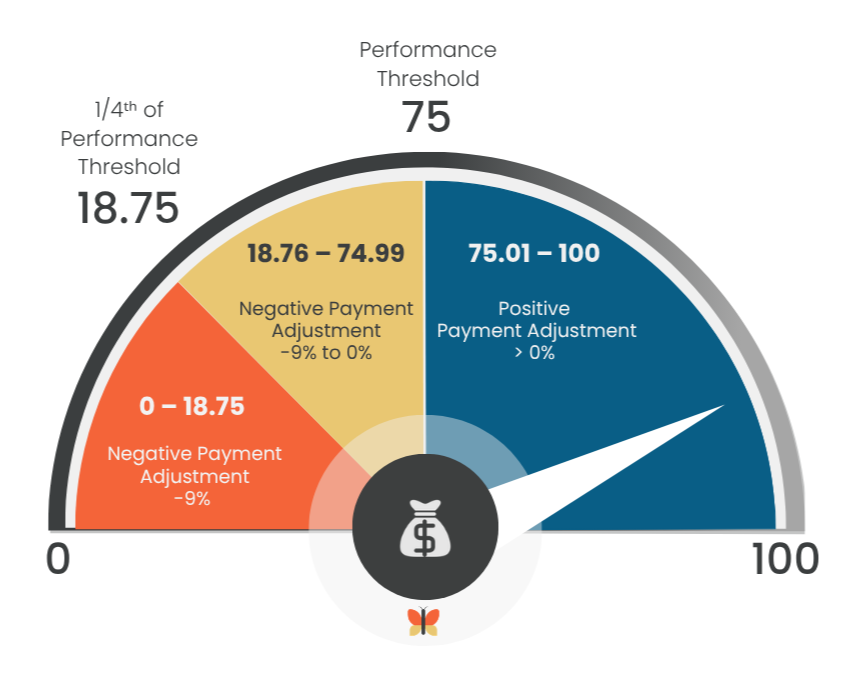
75 points: Neutral performance threshold
0 to 18.75 points: Maximum negative adjustment of -9%
18.75 to 74.9 points: Scaled negative adjustment between -9% and 0%
Above 75 points: Positive payment adjustment, subject to budget-neutral scaling
MIPS is budget-neutral, so positive payment adjustments depend on the penalties collected and the distribution of scores among participating clinicians.
How MyMipsScore helps
MyMipsScore gives EHRs and provider organizations year-round visibility into measure performance, category scores, and the projected final MIPS score.
Teams can compare measures and reporting options to understand how decisions may affect the final score before submission.
Review your 2026 projected MIPS score →How the final MIPS score and payment adjustment work

Bring MIPS into one connected workflow
MIPS affects more than reporting.
For EHRs, it is an opportunity to expand customer support and add a new revenue stream.
For Provider Organizations, it affects performance, operations, and financial outcomes.
As a CMS Qualified Registry with ONC-certified health IT, MyMipsScore brings current-year requirements, performance tracking, documentation, and submission into one workflow.
EHRs
Turn MIPS support into a customer and revenue advantage
Offer MIPS along with your EHR instead of sending customers elsewhere. Expand MIPS capabilities of your EHR with MyMipsScore, improve customer support, strengthen retention, and create a new revenue stream without building everything in-house.
Provider Organizations
Manage MIPS with more clarity and fewer surprises
Bring performance tracking, documentation, and submission into one place. MyMipsScore gives teams year-round score visibility and gives leadership a clearer view of reporting readiness and financial impact before submission.