ePA: Why Production Comes Before Certification
For years, EHRs have lived in a familiar regulatory rhythm: the rule is finalized, the ONC certification criteria are defined, development work begins, testing follows, certification is achieved, and only then does the market move toward broad adoption in production.
Electronic Prior Authorization (ePA) may not follow that traditional path. As the federal government accelerates ePA expectations, the practical timeline for EHRs will be driven by the urgent need to support real-world production workflows instead of certification. The cart is moving before the horse, and that is exactly the point.
CMS expects providers, payers, EHRs, networks, and technology developers to prepare for ePA NOW and be ready by the beginning of 2027 with API integration and certified capabilities. To meet that timeline, the testing, training, and pilot participation for ePA readiness needs to begin now for EHRs and providers.
⚡ CMS’s ePA urgency signal for providers and EHR vendors: “Act now to start submitting prior authorization requests electronically in 2027.”
The federal government is prioritizing ePA
The CMS Interoperability and Prior Authorization Final Rule, CMS-0057-F, established the regulatory foundation for standardized electronic prior authorization (ePA). Beginning in 2027, impacted payers must support prior authorization APIs, and clinicians and hospitals will need to utilize ePA under the MIPS (Promoting Interoperability) and Medicare Promoting Interoperability programs.
After the rule was finalized, HHS Secretary Robert F. Kennedy Jr. and CMS Administrator Dr. Mehmet Oz pledged to fix prior authorization, with payers committing to reduce the scope of services subject to prior authorization, standardize the ePA, improve transparency, and move toward faster care decisions.
CMS then followed with its Electronic Prior Authorization Acceleration initiative, naming early adopters across health systems, EHRs, networks, payers, and digital health companies. The purpose is clear: identify implementation barriers, test real-world workflows, and build momentum before the 2027 deadline.
⚠️This is where the market signal becomes especially important for EHR developers. CMS is not saying, “certify later.” CMS is saying, “Start moving now.”
For ePA, production trumps ONC certification
ONC’s HTI-4 rule created the certification framework for electronic prior authorization (ePA). The new criteria include:
(g)(31) - Prior Authorization API: Providers can request coverage requirements, documentation templates, and prior authorization requirements
(g)(32) - Prior Authorization API: Providers can submit prior authorization requests
(g)(33) - Prior Authorization API: Providers can query prior authorization status
(j)(20) - Workflow triggers for decision support interventions for clients
Together, these criteria are designed to support the core ePA transaction flow: coverage requirements, discovery, documentation templates and rules, and prior authorization support.
In simple words, the ePA workflow is not just a certification checkbox. It is a complete operational loop that covers:
Can the provider determine whether prior authorization is required?
Can the EHR help assemble the documentation that is needed?
Can the request be submitted electronically?
Can the status and decision be returned to the workflow?
Can the process reduce portals, faxes, manual follow-up, and administrative burden?
That is the real test. Certification will matter, but production performance will define success.
Why is “cart before the horse” the right ePA strategy
Historically, EHRs have often waited for ONC certification to mature before moving into production deployment. For ePA, that approach will simply not work.
Payers are being pushed to implement FHIR-based prior authorization APIs, and Providers are being encouraged to ask their EHR about readiness. CMS has created an early-adopter ecosystem to address implementation barriers before the deadline. HHS and CMS leadership are publicly framing prior authorization reform as a priority for patient access, provider burden, and administrative efficiency. That has created a different dynamic.
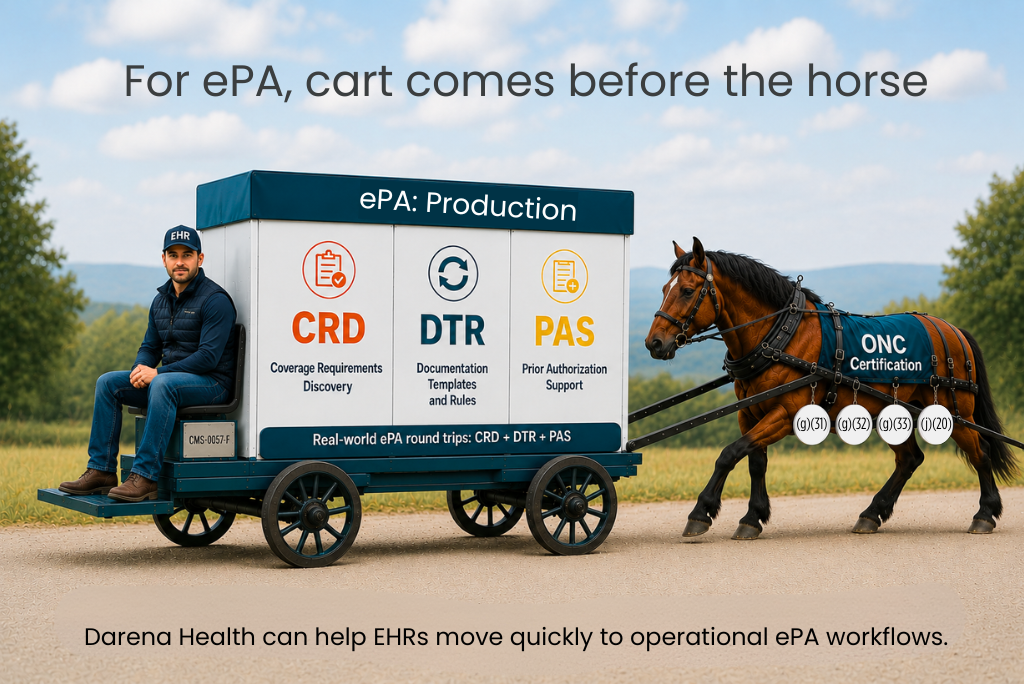
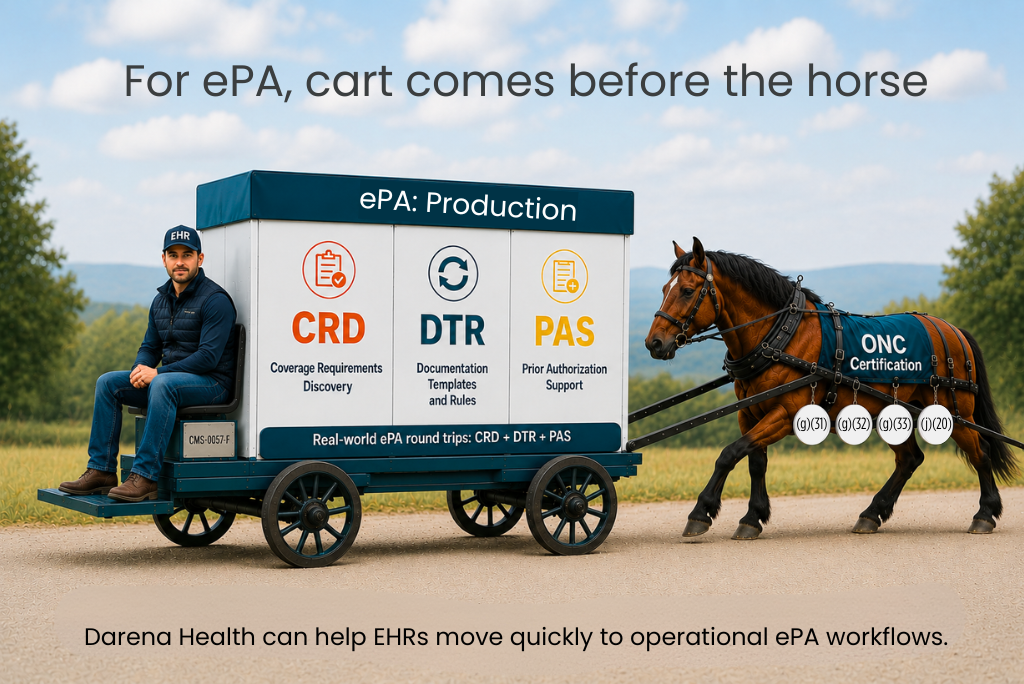
For ePA, the real-world production capability is the “cart” with:
CRD - Coverage Requirements Discovery
DTR - Documentation Templates and Rules
PAS - Prior Authorization Support
FHIR - based payer connectivity
EHR workflow integration
Real-world testing
Production round-trip
Provider adoption
Operational support
ONC certification is now the “horse” carrying the following criteria:
(g)(31) - Provider prior authorization API - coverage requirements discovery
(g)(32) - Provider prior authorization API - documentation templates and rules
(g)(33) - Provider prior authorization API - prior authorization support
(j)(20) - Workflow triggers for decision support interventions - clients
Both the “horse” and the “cart” are necessary for ePA implementation, but production readiness must come first.
ePA - another “Build or Buy” decision for EHRs
Every EHR now faces a strategic decision - Build your own ePA solution from scratch or integrate with a ready-to-go module.
Building ePA would involve interpreting evolving implementation guides, developing the payer connectivity strategy, developing CRD/DTR/PAS workflows, building EHR integration points, obtaining certification, supporting real-world deployment, and maintaining the ePA solution as standards and payer requirements evolve.
Or EHRs can move faster by working with a partner like Darena Health, which has demonstrated early leadership in the regulatory space.
Factors to consider
Hidden Costs
Building internally may appear attractive at first, but the hidden costs quickly add up:
Product management time
Engineering resources
Regulatory interpretation
Implementation guide, monitoring, and execution
Testing and certification preparation
Payer connectivity coordination
Provider training
Support infrastructure
Maintenance as standards evolve
Opportunity cost against other roadmap priorities
Operational burden
Additionally, ePA has a higher operational burden than many certification criteria because it must work across EHRs, providers, payers, intermediaries, documentation sources, and real-time workflow expectations. A checkbox approach will not be enough.
Provider and Payer Expectations
Providers using an EHR will expect the workflow to reduce burden, with fewer portals and faxes. CMS will expect measurable electronic adoption. Payers will expect APIs they implement to work seamlessly. EHRs must be ready for all these.
Functional experience and capability
ePA is not an isolated requirement. Its successful implementation requires experience in FHIR APIs, CDS Hooks-style workflow triggers, clinical documentation, and a good understanding of payer rules and the ONC certification process. Working with an experienced partner who can handle the heavy lifting across all these areas can give EHRs speed without the hassle.
⚡Experience matters. Darena Health was among the first to get the ONC certification for (g)(10) Standardized API for patient and population services and (b)(11) Decision Support Interventions criteria. Many specialty EHRs benefit from integrating with our certified ONC modules. Your EHR can too.
Smart ePA strategy – work with a partner
Darena Health is positioned to help EHRs move quickly on real-world ePA workflows while preparing for the next ONC certification modules. We are focused on helping EHRs prepare for real-world CRD, DTR, and PAS workflows now, while aligning the solution pathway with the emerging ONC certification expectations for (g)(31), (g)(32), (g)(33), and (j)(20).
For EHRs, this means:
Move faster than a ground-up internal build
Reduce regulatory uncertainty
Leverage Darena Health’s prior certification experience
Support real-world ePA workflow readiness
Prepare for future ONC certification expectations
Preserve internal engineering capacity
Offer customers a practical ePA roadmap now (a revenue-generating value-added service)
Avoid being left behind as payers and providers move toward 2027
ePA can become your differentiator
ePA will quickly become an expectation before it becomes a regulatory requirement. Providers are tired of portals, faxes, phone calls, missing documentation, unclear status, delayed decisions, and administrative rework. This time, providers can see a benefit to their bottom line. They will increasingly expect their EHR vendors to help simplify the process.
The EHRs that can credibly say they are preparing for production ePA workflows will have a stronger story for current customers and prospects. The EHRs that wait too long may find themselves explaining why they are still planning while others are already piloting, integrating, and demonstrating real-world readiness.
Darena Health can help EHRs turn this requirement into a value-added capability.
⚡See the ePA process in Action - July 14 – 16, 2026
Darena Health will participate in the Da Vinci electronic Prior Authorization track as part of the CMS HL7 FHIR Connectathon. We will be testing the Coverage Requirements Discovery (CRD), Documentation Templates and Rules (DTR), and Prior Authorization Support (PAS) workflows with other industry stakeholders. We welcome attendees to watch the interoperability testing process in action online. Learn more about the Da Vinci Burden Reduction Track.
The cart is moving
Now is the time for EHRs to decide whether they want to build from scratch or accelerate with a partner that already understands FHIR, certification, interoperability, decision support, and production deployment.