MIPS and MVP Support: One More Plate EHRs Don’t Need to Spin

For years, EHRs have been pulled beyond their core role. Along with documentation, scheduling, billing, workflows, interoperability, security, certification updates, and customer requests, providers now expect their EHR to help them succeed in MIPS.
MIPS requires measure selection, data capture, performance tracking, category strategy, education, and CMS submission support. With MIPS Value Pathways (MVPs) becoming a bigger part of the program, EHRs are being asked to support an even more complex reporting decision.
The next phase of MIPS support will come down to four capabilities: broader measure coverage, category-level support, certified infrastructure, and practical MVP guidance. The challenge is delivering all four without adding MIPS and MVPs as another plate for the EHR product, engineering, and support teams to keep spinning.
EHRs do not have to carry that plate alone. Darena Health can help deliver these capabilities more scalably.
eCQMs alone are not enough
Historically, many EHRs have approached MIPS through eCQMs. That makes sense as eCQMs are closely tied to ONC certification and clinical documentation workflows, but they are only a part of MIPS-related responsibilities.
Provider organizations often need more flexibility than a limited set of eCQMs that an EHR can provide. The best measures for providers depend on specialty, workflow, patient population, available data, and scoring potential.
“When provider organizations are limited to only a few measures, they may also be limited in how well they can score in MIPS.”
Darena’s MyMipsScore supports both eCQMs and MIPS-CQMs (registry measures). That broader coverage gives EHRs’ customers more reporting options and strengthens EHRs' MIPS offerings without forcing development teams to maintain every measure themselves.
This is especially important for specialty EHRs and multi-specialty practices. Their workflows do not always fit neatly into an EHR’s available eCQM inventory. Giving these practices access to both eCQMs and MIPS-CQMs creates a more practical path to better MIPS outcomes. Additionally, the smaller set of quality measures within the specialty MVPs includes measures that can only be reported as MIPS-CQMs.
MIPS support must cover more than Quality
MIPS is a multi-category program. A narrow Quality-only approach leaves gaps that provider organizations still expect someone to fill. A complete MIPS support model needs to address:
Quality: Support for eCQMs and MIPS-CQMs so providers have a broader measure inventory and better options for scoring strategy.
Promoting Interoperability: Support for requirements tied to certified EHR use, patient access, health information exchange, public health reporting, and related workflows.
Improvement Activities: Help identify applicable activities, collect documentation, and manage reporting requirements.
Submission to CMS: A reliable path for final submission, validation, and issue resolution.
Darena’s MyMipsScore supports all categories, including CMS Qualified Registry submission. That means EHRs can offer comprehensive MIPS support without having to do heavy lifting themselves.
MVP support is not just another checkbox
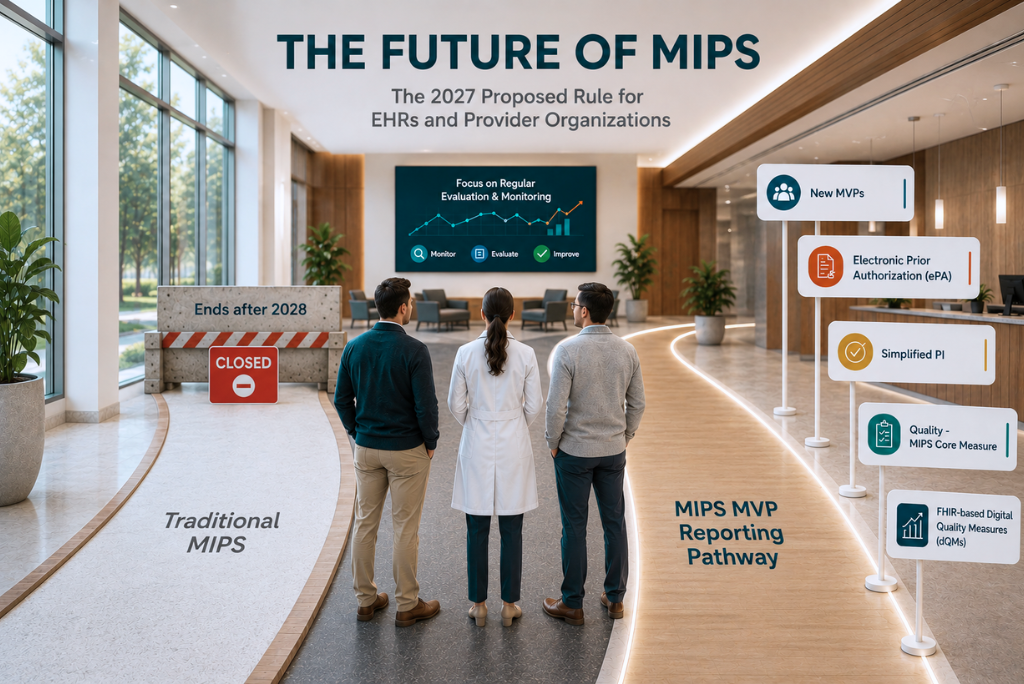
MVPs are intended to be a simpler, more specialty-aligned way to report MIPS. However, EHRs should not mistake “more structured” for “easy to support.”
MVPs introduce new planning questions for providers:
Which MVP fits their specialty or clinical focus?
Which quality measures are available within that MVP?
Is the MVP path better than Traditional MIPS for their situation?
Does subgroup reporting apply?
Has registration been completed on time?
What workflow or data gaps need to be fixed before submission?
Provider organizations need guidance before they commit to a reporting path. They need help determining whether the available measures align with their data and workflows. They need to know if reporting MVP is practical for them before it’s too late.
For EHRs, MVP support is becoming a customer experience issue. If the MVP path fails late in the reporting year, the EHR will be pulled into the escalation. If measure mapping or data capture is incomplete, the issue will often appear to be an EHR problem.
The strongest strategy for EHRs is to provide customers with a smarter MIPS support layer that integrates with the EHR, rather than turning its product, engineering, and support teams into full-time MIPS experts. MyMipsScore can be that layer.
Certified infrastructure reduces the burden
Maintaining MIPS support is not only a reporting challenge. It also affects certification planning.
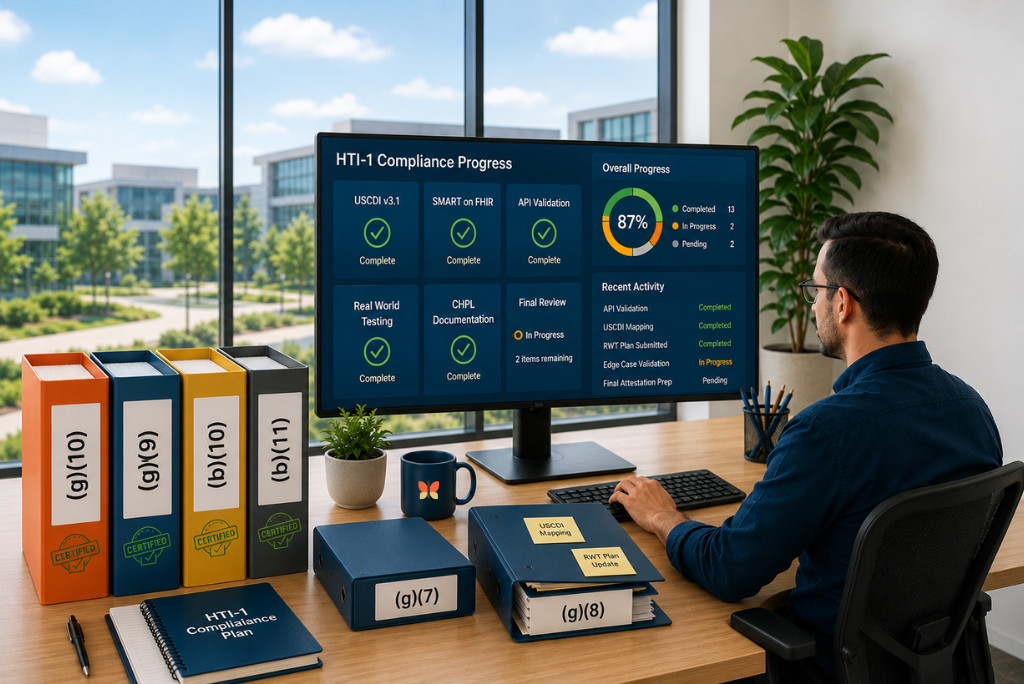
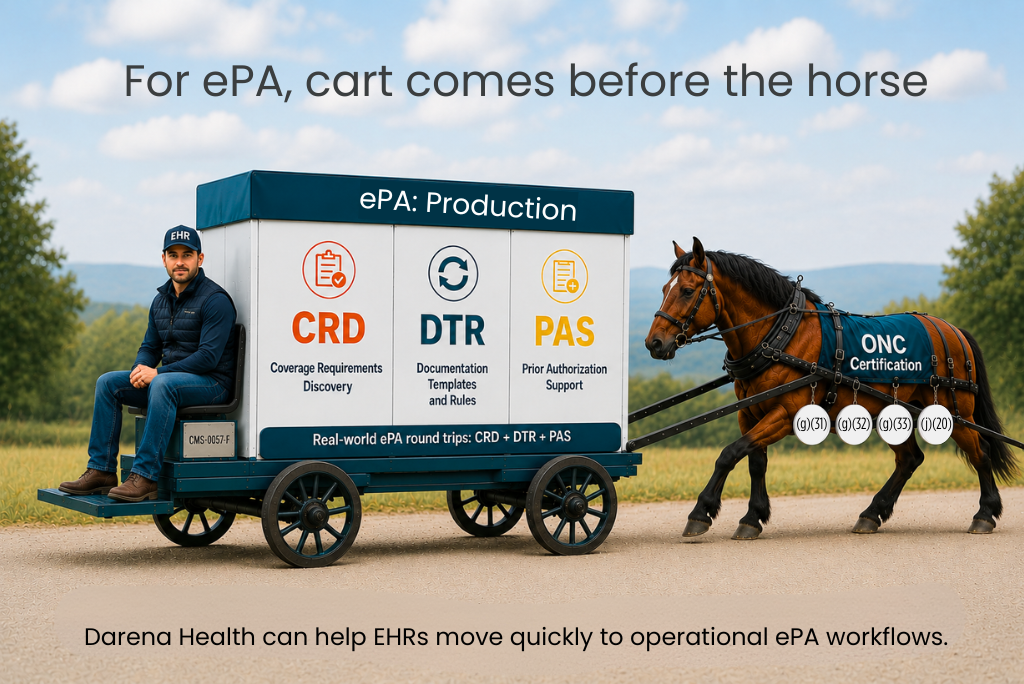
Darena Health has ONC-certified modules for the (c)(1) through (c)(4) clinical quality measure criteria. That gives EHRs a practical way to support certified quality measure capabilities without carrying the full ongoing burden of maintaining those criteria independently on their own CHPL listing.
Darena Health also supports certified capabilities such as the (g)(10) FHIR API, which is required for the Provide Patient Access measure for the Promoting Interoperability category, as the interoperability expectations continue to shape MIPS and broader federal health IT requirements.
For EHRs, this matters because certification maintenance is not a one-time project. It requires updates, testing, documentation, regulatory review, and ongoing operational attention. Every performance year brings new details, measure updates, and customer questions.
By leveraging Darena Health’s certified infrastructure, EHRs can stay focused on their core product while still giving customers access to the MIPS capabilities they need.
A better MIPS strategy for EHRs
MIPS is no longer something EHRs can treat as a small add-on. Provider organizations want broader measure options, clearer reporting guidance, category-level support, MVP readiness, and a dependable path to CMS submission. They also want the process to feel connected to the EHR they already use.
For EHRs, that creates a strategic choice. EHRs can continue expanding internal MIPS support each year, bringing the product, engineering, compliance, and customer support teams into a program that keeps evolving. Or they can partner with a team that already lives in that world.
MyMipsScore helps EHRs offer a more complete MIPS and MVP solution backed by:
Support for eCQMs and MIPS-CQMs
Quality, Promoting Interoperability, and Improvement Activities support
CMS Qualified Registry submission
ONC-certified quality measure capabilities
MVP guidance and reporting path analysis
Experience supporting specialty-focused EHRs and provider organizations
A practical way to turn MIPS into a revenue-producing value-added service
For EHRs, the advantage is simple: less internal burden, broader customer support, and a stronger MIPS offering without building and maintaining the entire infrastructure themself.
It means MIPS can become more than an annual support drain. It can become a service that provider organizations value – a more cohesive experience for selecting measures, tracking performance, and submitting.
If your EHR is being asked to support MIPS MVPs, broader measure options, or CMS submission, now is the time to rethink what your team should own internally.