HTI-1 Compliance: Certification is just the beginning
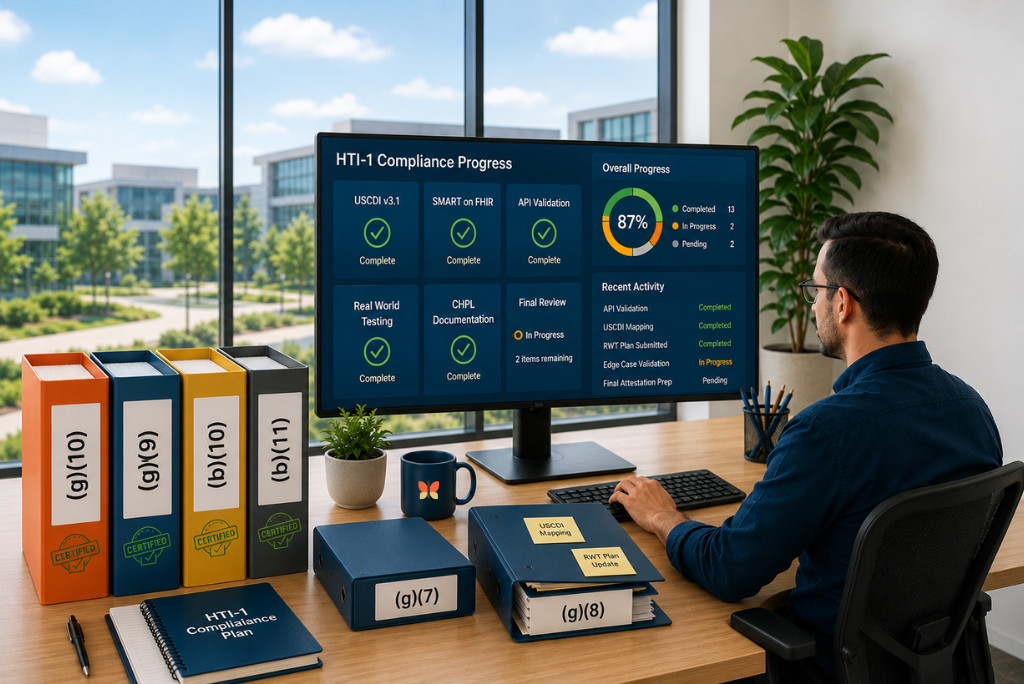
HTI-1 certification may be complete, but the work doesn't stop there. As products, APIs, and regulatory expectations evolve, EHRs need to ensure their certified capabilities continue to perform as expected, support providers, and meet ONC requirements.
Why it deserves your attention
HTI-1 raised the bar for certified Health IT. Beyond implementing the required certification criteria, EHR developers are responsible for keeping those capabilities functional, auditable, and ready for activities such as Real World Testing, customer implementations, and regulatory review.
Several HTI-1 capabilities deserve regular attention to ensure they continue to perform as expected in production.
(g)(10) Standardized API for Patient and Population Services
Some EHRs have met certification requirements but have not verified that their API endpoints deliver full, real-time access across all USCDI v3 elements. This can expose providers to information blocking risks.(b)(10) Electronic Health Information (EHI) Export
The EHI Export must be functional and usable. Providers need this capability to work reliably when responding to patient requests, transitions of care, or data migration.(b)(11) Decision Support Interventions (DSI)
Predictive DSIs are now under increased scrutiny from ONC. Under HTI-1, EHRs and Health IT vendors must document the logic, evidence, and transparency of DSIs to ensure clinicians understand how decisions are generated.
Where problems usually surface
Even certified capabilities can become a source of risk if they are incomplete, outdated, or don't perform consistently in production. Providers rely on certified technology for compliance, reporting, and audit defense. If your (g)(9) or (g)(10) APIs do not enable true patient access or your (b)(10) exports are incomplete, EHRs risk not only regulatory action but loss of customer trust.
The ONC’s heightened focus on information blocking enforcement means incomplete or non-functional implementations can have legal and reputational consequences.
How Darena Health Helps
Darena Health's pre-certified modules help EHRs and Health IT vendors add and maintain key HTI-1 capabilities without taking on the cost and complexity of developing them in-house.
Our HTI-1 certified solutions include:
(b)(10) EHI Export for individual and bulk data sharing
(b)(11) Decision Support Interventions (DSI) with transparent and explainable models
(g)(7) Application Access – Patient Selection
(g)(9) Application Registration and Authorization for secure and consistent app connections
(g)(10) Standardized APIs supporting SMART on FHIR v2.2 for both patient and population-level access
Each module is fully certified, integrated with CHPL documentation, Real-World Testing (RWT) plans, and evidence kits.
With Darena Health, EHRs can:
Ensure compliance with USCDI v3.1
Maintain consistent patient access and data exchange
Offload RWT preparation and audit documentation
Accelerate implementation with certified, integration-ready modules
Support compliant information sharing and reduce information blocking risk
Why Proactive HTI-1 Compliance Monitoring
HTI-1 compliance gaps can surface during any product release, customer deployment, or regulatory review. Addressing them proactively reduces rework, minimizes risk, and helps teams avoid unnecessary fire drills. Finding gaps early is far easier than addressing them under time pressure later.
Integrating Darena Health’s certified modules helps EHRs:
Keep your CEHRT at or above HTI-1 standards
Protect your customers (providers) from information blocking exposure
Free up your engineering teams to focus on innovation
Learn how you too can maintain continuous HTI-1 compliance
RECENT BLOGS