
Darena Health Blog and News

What to do if your MIPS registry shuts down
CMS placed 11 Qualified Registries under remedial action and terminated 7 in 2026. This blog explains what these changes mean for clinicians, practices, groups, ACOs, and registry organizations; what to do with MIPS work already completed; and how to plan for 2026 reporting.
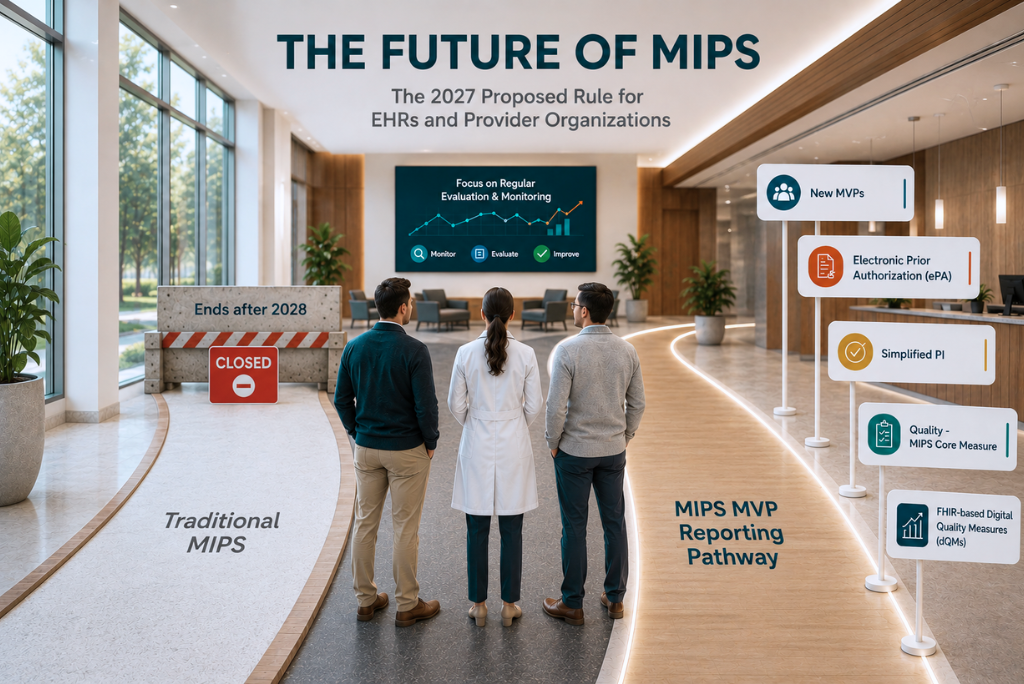
2027 MIPS Proposed Rule: 7 Key Changes to Note
The 2027 MIPS Proposed Rule has 7 significant changes that could reshape MIPS reporting. These include new MVPs, new MIPS Core Measures, ACO reporting, ePA measure, and FHIR-based digital quality measurement. Read what EHRs and provider organizations should prepare for.

HTI-1 Compliance: Certification is just the beginning
HTI-1 compliance doesn't end with certification. Learn how EHRs can maintain FHIR APIs, EHI Export, Decision Support Interventions, Real World Testing, and other ONC-certified capabilities to reduce compliance risk and support reliable interoperability.

HTI-1 Compliance Checklist for EHRs and Health IT Teams
HTI-1 compliance involves much more than implementing a FHIR API. This practical checklist helps EHRs and health IT teams evaluate certification, operations, SMART on FHIR, USCDI, EHI Export, Real World Testing, and whether to build internally or integrate with a certified partner.

Small but Mighty MIPS 2026 Changes
A closer look at the MIPS 2026 updates that can affect measure selection, reporting workflows, support priorities, and MIPS readiness for EHRs and Provider Organizations alike.

What EHRs Underestimate about Supporting MIPS
Learn why annual MIPS measure updates, maintaining ONC certification, and supporting submission workflows create more internal work than many EHR teams expect.

Failed Cures Act Implementation? Let MeldRx™ Rescue You.
January 1, 2023, is not just the beginning of a new year, it is also the beginning of the enforcement period for the Information Blocking portion of the Cures Act. The EHRs must provide FHIR APIs for all their users, and Providers must ensure that their FHIR API endpoints are publicly available.

ONC Announces Consequences of Cures Act Non-Compliance
The ONC has announced its punitive action plan to deal with non-compliant Health IT developers. EHRs failing compliance will undergo Direct Review, have to submit a Corrective Action Plan (CAP) and will be placed under a Certification Ban till they become compliant. Integrating with (g)(10) pre-certified BlueButtonPRO is an easy solution.

ONC's Latest Cures Act Hits: Featuring (g)(10) FHIR® API
Tune in to the message the ONC is broadcasting through their recent blogs/media to reinforce the need for (g)(10) FHIR® API and Information Blocking compliance, whom these apply to, and how the mandates will be enforced. Let’s turn up the volume on the latest hits from ONC.

Cures Act MYTHBUSTERS
The misinformation floating around combined with an incomplete understanding of the (g)(10) FHIR API and other Cures Act requirements can be detrimental to the EHR developers and the providers. In this blog, we bust these myths, shatter misconceptions, and guide you to ask the right questions.

Cures Act: A Patient's Perspective
With the Cures Act deadlines around the corner, the focus has been on “how” to meet the requirements, and not “why”. Let’s not forget that each one of us will be a patient at some point in our lives. When we are the patient, we want Health IT to work for us. We need access to our health data for that and Cures Act makes it possible. This personal experience will make that evident.

Have (g)(10) FHIR API Burning Questions?
EHRs are feeling the heat of Cures Act requirements as the deadlines draw closer. Read on to find answers to burning questions that EHR developers and providers are faced with as they are trying to understand the implementation details of the (g)(10) FHIR API and its implications.

Interoperability: There is FHIR® at the End of the Tunnel
Over the last decade, billions of American taxpayer dollars have been spent to achieve “interoperability” in healthcare. Has it worked? The answer depends on who you ask. However, everyone agrees that we have a long way to go. Is FHIR® the answer to the interoperability conundrum?

Am I an Information Blocker: A $1,000,000 Question
On October 29th, 2020, ONC announced an Interim Final Rule to extend compliance for some of the provisions including Information Blocking due to the COVID-19 pandemic. In this blog, we discuss what changed in the Interim Final Rule, how it impacts providers and EHR vendors, and solutions for meeting the Information Blocking requirements.

Get Ready for Cures Act With Azure API For FHIR®
There is a lot of confusion on what exactly the 21st Century Cures Act requires and includes. We help break down the law and demonstrate how we are helping our clients meet the requirements using Azure API for FHIR®.

Patient Engagement On FHIR® in 7 Steps
In a previous blog and the recent webinar, we discussed how CMS has redefined the Patient Engagement requirements under MIPS in 2019. In the proposed rule announced during HIMSS, ONC proposed a new certification criterion targeted towards those objectives that EHRs will need to support going forward. There is a lot of concern (and confusion) specially regarding the security requirements related to “enabling access for patients to their medical records”. This blog provides clarification regarding these requirements and the associated security concerns.

Azure Cosmos DB & HL7® FHIR® - A Match Made in Heaven?
The key differentiator of FHIR from any previous standards used in the healthcare is the portability of FHIR “resources”. This granular approach to storing and consuming healthcare data opens up many more new opportunities as compared to the traditional document-based methods. However, this approach also presents some challenges. Can Azure Cosmos DB be the perfect solution to those challenges?