2027 MIPS Proposed Rule: 7 Key Changes to Note
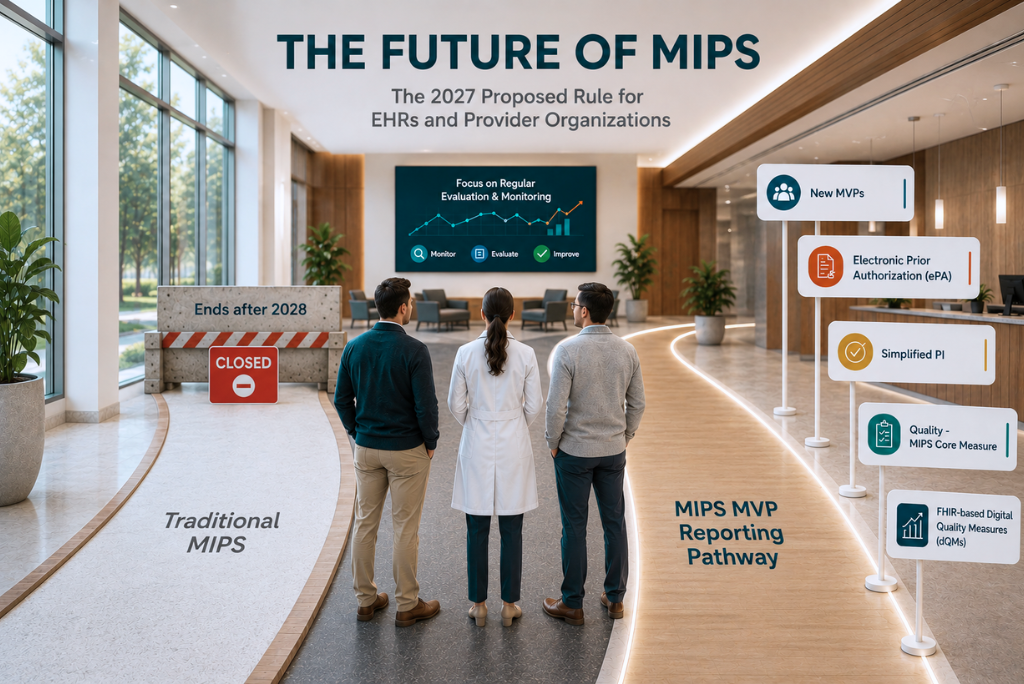
Most MIPS proposed rules focus on annual updates, such as quality measures, scoring policies, and reporting requirements. The 2027 MIPS Proposed Rule goes further. It proposes retiring Traditional MIPS after the 2028 performance year, along with changes to MIPS Value Pathways (MVPs), quality measures, the new MIPS Core Measure requirement, Electronic Prior Authorization (ePA), Improvement Activities, and FHIR-based digital quality measurement.
The proposed rule is still subject to change before it becomes final. EHRs and provider organizations do not need to begin making changes now. However, understanding the proposed changes can help organizations evaluate whether their products, reporting strategy, and operational processes will continue to support MIPS as the program evolves.
The sections below explain the key proposed changes, their potential impact on EHRs and provider organizations, and our solution to help simplify the transition.
1. MVPs to completely replace Traditional MIPS
If finalized, the proposed retirement of Traditional MIPS would make MIPS Value Pathways (MVPs) the primary reporting pathway for most MIPS participants beginning in 2029. The proposed rule reinforces that direction by introducing three new MVPs for Diabetic Disease, Hospitalist Care, and Hypertension Management, while updating all 27 existing MVPs, resulting in 30 available MVPs for the 2027 performance year.
EHRs should prepare to:
- Continue supporting Traditional MIPS through the 2027 and 2028 performance years while shifting development toward an MVP-first strategy.
- Identify which of the 30 proposed MVPs are most relevant to their specialties and customers.
- Prepare to support specialty-specific workflows, MVP measure selection, subgroup reporting, and MVP-level performance tracking.
Provider organizations should prepare to:
- Understand how MVP reporting requirements differ from Traditional MIPS before making the transition.
- Start planning for MVP reporting before Traditional MIPS is retired.
- Select the MVP that best aligns with their specialty and patient population and begin monitoring the applicable measures.
- Review the Quality, Cost, Improvement Activities, and population health measures included in the selected MVP.
2. Structural change to Quality category
The proposed rule introduces a new “MIPS Core Measure” requirement to replace the one outcome measure (or a high-priority measure when an outcome measure is not available) currently required. Large practices (16 or more NPIs) would be required to report one MIPS Core Measure as part of their Quality category submission or submit an attestation if they can’t and submit another measure instead. If both these conditions are not met, they will earn a score of zero for that measure. Small practices (1-15 NPIs) would be exempt from this requirement.
The requirement would apply to both reporting pathways:
Traditional MIPS: One of the six reported quality measures would need to be a designated MIPS Core Measure.
MVPs: One of the four reported quality measures would need to be a designated MIPS Core Measure.
CMS is also proposing changes to the Quality measure inventory for the 2027 performance year - remove 20 measures, revise 43 existing measures, and introduce several new and replacement measures.
⚡EHRs and provider organizations must adequately prepare for the most significant structural change in the Quality category since the inception of MIPS.
They must review the Quality measures and not assume 2026 measures will remain available or unchanged.
EHRs should prepare to:
- Update quality measure logic, value sets, data mappings, exclusions, and calculation rules.
- Support MIPS Core Measure selection for both Traditional MIPS and MVP reporting.
- Review Quality reporting workflows to align with the proposed 2027 quality measures.
- Enable organizations to document when a MIPS Core Measure does not fit their clinical operations.
Provider organizations should prepare to:
- Review their Quality measure strategy for 2027 rather than automatically reusing their 2026 selections.
- Identify the designated MIPS Core Measure that best fits their reporting requirements.
- Work with their EHR or reporting vendor to understand how the proposed measure changes could affect reporting and performance.
3. Promoting Interoperability will include Electronic Prior Authorization
Providers could earn bonus credit for completing at least one qualifying medical electronic prior authorization (ePA) in 2027. Beginning in 2028, both medical and prescription drug ePA would become part of MIPS reporting, making electronic prior authorization a standard part of performance reporting rather than an optional capability.
CMS is also proposing removal of MIPS Security Risk Analysis attestation from the Promoting Interoperability category, reducing reporting burden without changing existing HIPAA security obligations.
EHRs should prepare to:
- Develop or integrate electronic prior authorization capabilities that can support the proposed MIPS reporting requirements.
- Update Promoting Interoperability workflows if the proposed reporting changes are finalized.
- Continue planning for HTI-5 certification changes that support future interoperability requirements.
Provider organizations should prepare to:
- Begin incorporating electronic prior authorization into clinical workflows ahead of the proposed 2028 requirements.
- Confirm that their EHR supports the necessary electronic prior authorization capabilities and test operational readiness in advance.
- Continue meeting their existing HIPAA security obligations.
Want to learn more about preparing for ePA? Read: ePA: Why Production Comes Before Certification
4. Improvement Activities are expanding to support emerging models of care
The proposed rule refreshes the Improvement Activities category with new activities that reflect how healthcare is evolving. New options focus on areas such as AI, clinical pathways, nutrition and social needs, advance care planning, and lifestyle-based diabetes interventions, while outdated activities are retired or updated.
EHRs should prepare to:
- Review whether their systems can capture the documentation providers will need for the proposed new Improvement Activities.
- Make it easy for providers to record, track, and report applicable Improvement Activities.
Provider organizations should prepare to:
- Review which proposed new Improvement Activities fit their clinical operations and patient populations.
- Maintain clear documentation throughout the performance year to support Improvement Activity reporting.
5. Registry and ACO reporting is changing
The proposed rule introduces new reporting options for providers that participate in Medicare Shared Savings Program (MSSP) Accountable Care Organizations (ACOs) or submit MIPS data through a registry. It also proposes new audit, documentation, and reporting requirements for Qualified Clinical Data Registries (QCDRs), Qualified Registries (QR), and other organizations that submit MIPS data on behalf of providers.
EHRs should prepare to:
- Determine whether their systems support the proposed MIPS reporting options for customers participating in MSSP ACOs or reporting through QCDRs and Qualified Registries.
- Support the recording and reporting of the newly proposed Medicare eCQM.
- Support the proposed alternative methods for demonstrating the use of Certified EHR Technology.
Provider organizations should prepare to:
- Review how the proposed changes could affect their reporting process if they report through a registry or participate in an MSSP ACO.
- Verify that their EHR supports the measures they intend to report, including eCQMs, MIPS CQMs, and the proposed Medicare eCQMs.
- Coordinate Certified EHR Technology use and data completeness across all participating practices.
6. Digital Quality Measurement is gaining momentum
CMS is seeking feedback on a phased transition to FHIR-based digital Quality Measurement (dQM), with a potential transition beginning in 2028 and mandatory reporting for applicable measures beginning in 2030. While these timelines are not final, they signal where quality reporting is headed.
EHRs should prepare to:
- Evaluate their readiness for FHIR-based digital quality reporting.
- Identify gaps in data capture, interoperability, and measure calculation.
- Develop a roadmap for supporting digital quality measures as CMS moves toward FHIR-based reporting.
Provider organizations should prepare to:
- Understand how digital quality measures could affect future reporting workflows and data requirements.
- Work with their EHR and reporting partners to prepare for a potential transition to FHIR-based quality measurement.
7. Additional changes for provider organizations
MVP participants should prepare for:
- The possibility that MVP Improvement Activities and Promoting Interoperability results could be publicly reported without the current one-year delay.
- Greater visibility into performance results shortly after data is submitted.
Advanced APM participants should prepare to:
- Review Qualifying APM Participant status separately for each Taxpayer Identification Number under which a clinician furnishes services.
- Determine whether clinicians working across multiple practices could qualify for a MIPS exemption under one TIN but remain subject to MIPS under another.
Have feedback on the proposed rule? ✍️
CMS is accepting public comments on the 2027 MIPS Proposed Rule through Monday, September 14, 2026. If your EHR or Provider organization will be affected by these proposed changes, this is an opportunity to share feedback before the rule is finalized.
When submitting comments, reference File Code: CMS-1848-P.
Prepare for the future of MIPS – 2027 and beyond
The 2027 proposed changes affect every stage of MIPS.
Choosing between Traditional MIPS and MVPs
Adapting to new Quality measures – supporting and reporting them
Incorporating Electronic Prior Authorization (ePA)
Supporting changes for Promoting Interoperability and Improvement Activities
Managing CMS submission
All of these require greater visibility at the category level and a more connected process to be successful. MyMipsScore is designed to support EHRs, provider organizations, and MSOs in navigating this transition with confidence.
MyMipsScore is a complete MIPS platform that connects reporting path analysis, measure strategy, year-round performance monitoring, and CMS Qualified Registry submission in one end-to-end workflow. Teams can compare Traditional MIPS and MVPs before reporting begins, choose the best scoring measures for their organization, monitor progress across Quality, Promoting Interoperability, and Improvement Activities, and manage MIPS with greater confidence throughout the performance year.
Whether you're adding MIPS capabilities to your EHR or managing reporting across multiple multi-location practices using different EHRs, MyMipsScore provides the performance visibility and operational support needed to simplify MIPS today while preparing for tomorrow's reporting models.
Put your MIPS strategy into action with MyMipsScore
RECENT BLOGS